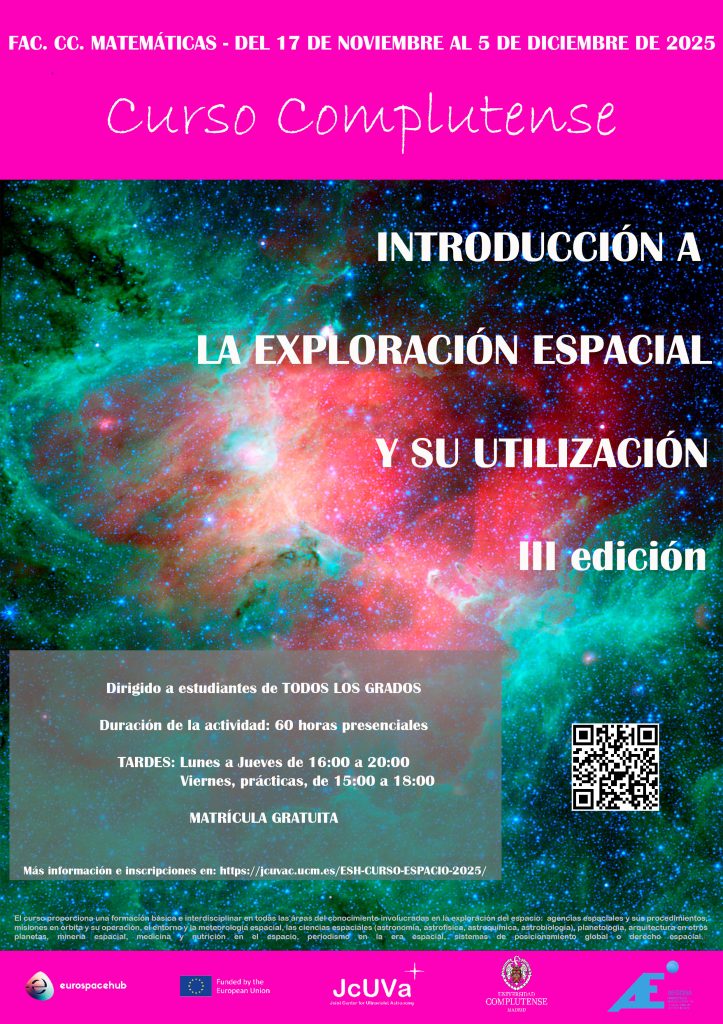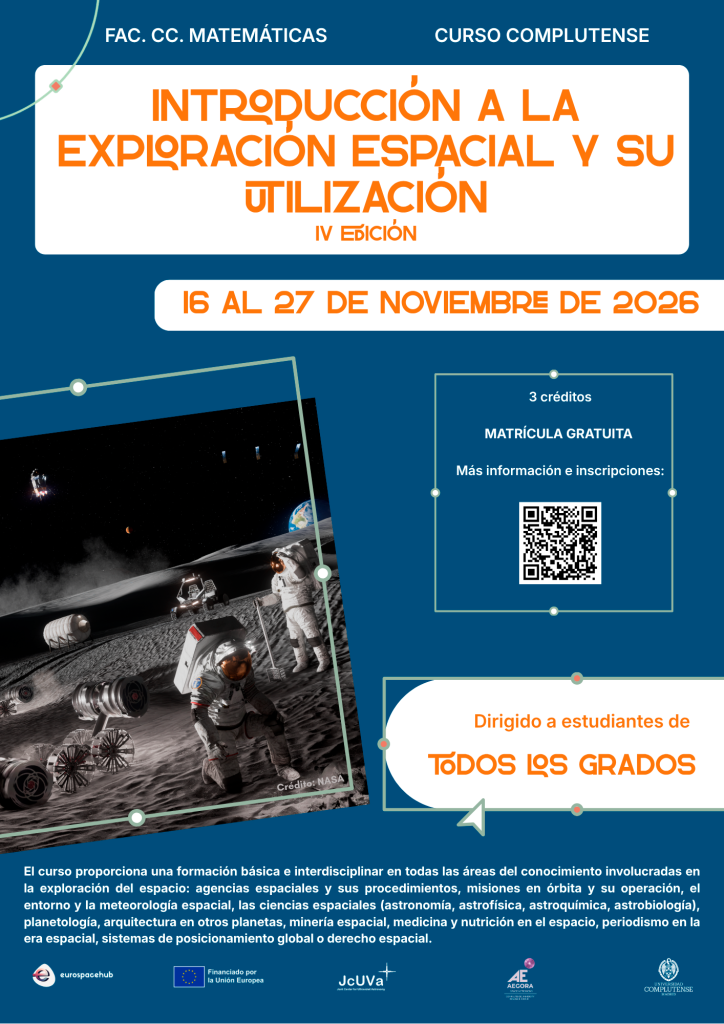
AEGORA Researcher Ada Canet Secures Fulbright Fellowship at UT Austin

Complutense University professor and AEGORA researcher, Ada Canet, has received a Fulbright postdoctoral fellowship to join the Department of Physics at the University of Texas at Austin. As part of this world-renowned program, Canet will advance her research on astrophysical plasmas. Her study examines the relationship between terrestrial planets and their host stars, seeking to determine whether these far-off worlds could support life.
 

  • 12:00  Welcome and introductions. Ana I. Gomez de Castro / UCM

  • 12:15  The HWO project and the Spanish Space Agency (AEE). Alicia Miró / AEE

  • 12:30  The HWO project – Participation of the Spanish scientific community. Ana I. Gómez de Castro / UCM

  • 13:00  The HWO project – Current status and future plans.

  • 13:00  The HWO Observatory – Breann Sitarski / NASA

  • 14:00 – 15:00  LUNCH BREAK

  • 15:00  The POLLUX instrument for HWO. Luca Fossatti / Univ. Vienna

  • 15:30  The HWO project in the UK. Plans for instrumentation. Martin A. Barstow / Leicester Univ.

  • 16:00  The LUMUS instrument for HWO. Kevin France / Univ. Colorado

  • 16:30 – 17:00  COFFEE BREAK

PRESENTATIONS by the Spanish Community:

  • 17:00  HWO Target stars. Jose Caballero / CAB-INTA-CSIC

  • 17:15  Why massive stars need to be in HWO. Miriam García / CAB-INTA-CSIC

  • 17:30  How prepared we are for the characterization of rocky exoplanets with HWO. Leonardo Gkouvelis / IAA-CSIC

  • 17:45  Expected performance of ELT and ANDES for small, potentially habitable planets research. Enric Pallé / IAC

  • 18:00  HWO and Solar System research. Fernando Tinaut

  • 18:15  Astrobiology. Ana I. Gómez de Castro

  • 18:30  Discussion and preparation for the following day.

Day 2, May 28th

  • 09:30  Presentations by the working groups regarding science and the type of data required.

  • 11:30  COFFEE BREAK

  • 12:00  Presentations by instrumentation and data engineering groups and/or institutions regarding capabilities and possibilities for HWO.

  • 14:00  LUNCH

  • 15:00  General Discussion:

    • Organization of the Spanish community for HWO.

    • Development of a work plan for the 2026–2027 period.

Full support of the Spanish HWO Working Group to three new instruments


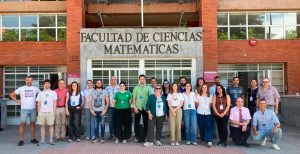
The Spanish working group of the Habitable Worlds Observatory (HWO), a joint mission by ESA and NASA, has taken a decisive step in its participation. During a meeting held on May 27th and 28th at the Faculty of Mathematical Sciences of the Universidad Complutense de Madrid (UCM), the community formalized its support for the development of three cutting-edge scientific instruments.

The HWO’s primary goal is the search for life on Earth-like planets. To
achieve this, the mission features a high-contrast coronagraph that will
allow scientists to study directly the atmospheres of potentially
habitable planets.

In this context, the Spanish group proposal focuses on three key technologies:

  • Multipurpose Spectropolarimeter: Designed for detailed studies of the Solar System, extrasolar planets, and massive stars.
  • Multi-Object Spectrograph (MOS) with an Integral Field Unit (IFU): Capable of capturing both images and spectra of extended objects, such as nebulae or comets.
  • High-Resolution Camera: Equipped with narrow, medium, and broadband filters for the precise observation of objects both within and outside our galaxy.

This endorsement solidifies the position of Spanish astrophysics in one of the most ambitious missions of the coming decades, ensuring that national technology plays a vital role in the discovery of life beyond our Solar System.

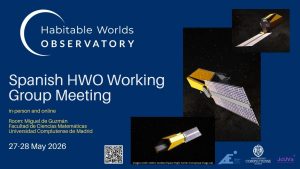
Spanish Working Group Meeting: NASA’s Habitable Worlds Observatory (HWO)

On May 27-28, 2026, the Universidad Complutense de Madrid (UCM) will host the Spanish working group meeting for NASA’s Habitable Worlds Observatory (HWO).

This hybrid event aims to establish a national science and instrumentation consortium to drive Spain’s involvement in NASA’s next flagship mission. The meeting will feature experts from NASA and European research teams to define the mission’s roadmap and technical contributions.

More information and registration here
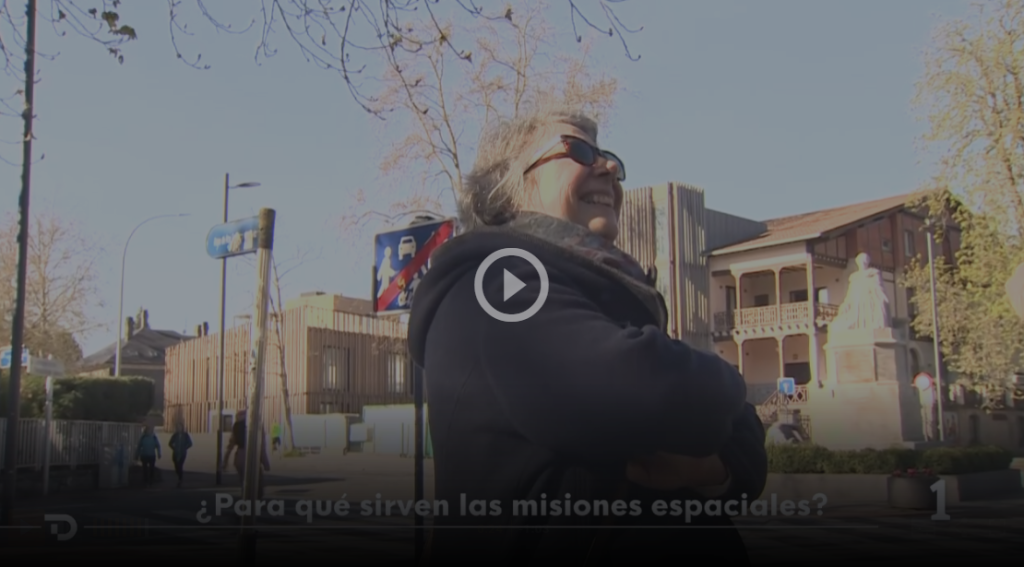
Ana Inés Gómez de Castro, Director of JCUVA, featured on RTVE

On the occasion of the recent Artemis II mission, our Director appeared on the news broadcast to highlight the significance of space missions for the daily lives of citizens. She noted: “We are sometimes oblivious to the fact that many discoveries driven by space exploration have reshaped our existence on Earth.”

Emphasizing that we inhabit a “space age,” she warned that a total satellite failure would have immediate consequences: “Planes would have to land, ships would lose their navigational accuracy, and mobile networks would experience severe malfunctions.”
III Virtual Congress of the Latin Lunar Lobby

The III Virtual Congress of The Latin Lunar Lobby is taking place from January 20 to 22, 2026 aimed at gathering and discussing potential science cases and observational programs that will shape the mission’s scientific legacy.

The Ultraviolet Lunar Observatory (OUL) , operating from a privileged orbit around the Moon and designed to explore the ultraviolet sky, will open new avenues for the study of the lunar surface, the Earth’s exosphere, as well as small bodies and the heliosphere.

Go to workshop page