
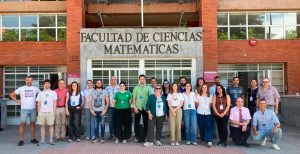
The Spanish working group of the Habitable Worlds Observatory (HWO), a joint mission by ESA and NASA, has taken a decisive step in its participation. During a meeting held on May 27th and 28th at the Faculty of Mathematical Sciences of the Universidad Complutense de Madrid (UCM), the community formalized its support for the development of three cutting-edge scientific instruments.
The HWO’s primary goal is the search for life on Earth-like planets. To
achieve this, the mission features a high-contrast coronagraph that will
allow scientists to study directly the atmospheres of potentially
habitable planets.
In this context, the Spanish group proposal focuses on three key technologies:
- Multipurpose Spectropolarimeter: Designed for detailed studies of the Solar System, extrasolar planets, and massive stars.
- Multi-Object Spectrograph (MOS) with an Integral Field Unit (IFU): Capable of capturing both images and spectra of extended objects, such as nebulae or comets.
- High-Resolution Camera: Equipped with narrow, medium, and broadband filters for the precise observation of objects both within and outside our galaxy.
This endorsement solidifies the position of Spanish astrophysics in one of the most ambitious missions of the coming decades, ensuring that national technology plays a vital role in the discovery of life beyond our Solar System.